From Private Rooms to Casino Resorts: A Business History
Casino resort history shows how venues paired gambling with lodging, dining and entertainment, helping readers distinguish a destination business from a larger gaming room.
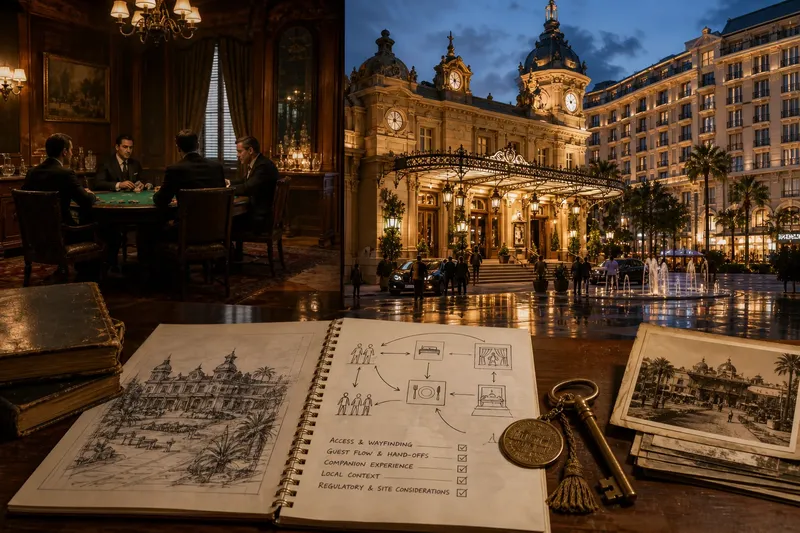
Casino resort history is not a universal march from private rooms to public resorts. Monte Carlo’s casino developed within a wider leisure project, while Las Vegas’s Strip grew as a cluster of visitor-facing properties.
What distinguishes a private room from a destination venue?
A private gambling room centred on an invited clientele. A destination venue, by contrast, sought to make the property itself a reason to travel or stay. The difference lies in its audience and offer, not simply the size of its gaming floor.
Monte Carlo illustrates the destination approach. The Société des Bains de Mer was established in the nineteenth century to develop leisure facilities in Monaco, including a casino and associated hospitality. Gambling formed part of a broader visitor offer rather than an isolated room-based activity.
Las Vegas followed a different path. Its resort Strip developed as a cluster of public-facing properties aimed at visitors, with hotels, restaurants and entertainment alongside gambling. These cases do not show that every private room became a resort; they show how local institutions, law and travel shaped distinct commercial arrangements.
Say a private club in an invented town considers opening its dining room to visitors. It has a members-only dining room, no public reception and a small staff; the owners decide to admit non-members for dinner on selected evenings and create a separate entrance. They expect to see whether visitors can reach the dining room without disrupting members. If the separate route works, they can retain limited public service; if it causes confusion or disrupts the club, they can return to restricted access.
How did Monte Carlo and Las Vegas shape different offers?
In Monte Carlo, the casino belonged to a broader leisure project associated with Monaco’s effort to attract visitors. The Société des Bains de Mer’s published history and Monaco’s institutional records are places to verify the company’s role and the development of its facilities. They document a particular setting, not a template for every casino.
Las Vegas’s Strip became known for hotels combining gambling with lodging, food and entertainment. The Nevada State Museum’s accounts of Las Vegas history and the University of Nevada, Las Vegas Special Collections’ archival material offer ways to examine the city’s development through records and images. These collections can help readers trace the visitor economy without assuming one model simply replaced another.
The comparison has limits. Monaco’s development was tied to a small principality and a leisure company; Las Vegas grew within a US city and state regulatory system. Their institutional and geographic conditions matter as much as the visible combination of casino, hotel and entertainment.
Why did hotels and entertainment join the offer?
Accommodation can turn an evening visit into an overnight stay. Restaurants, lounges and performances give companions options beyond the gaming floor and can appeal to visitors with different interests. Coordinated services make the property a destination rather than a place offering play alone.
That arrangement also creates operational demands. A resort has to coordinate accommodation, dining, entertainment, staffing and guest movement. Adding attractions without a clear purpose can make the offer harder to understand.
Imagine an invented resort-town operator with a dining room, no guest rooms and no evening performance. The operator reviews the current offer, then considers adding guest rooms and scheduling a regular show. The observable result to look for is whether guests can use lodging and attend the performance as part of one coherent visit. If the teams can coordinate both services and visitors want that joined-up offer, the additions address an identified gap; if not, the operator can retain a focused venue and avoid building a more complex business without a clear purpose.
What should an operator check before expanding?
Each observation should lead to a decision, not an automatic push to add more attractions.
- Visitors leave after one attraction: Check whether the offer depends on gambling or a single event. If so, consider a complementary service such as dining; if visitors already have useful options, retain the offer rather than adding something unrelated.
- Companions have nowhere comfortable to spend time: Check whether lounges, restaurants or performance spaces are accessible without crossing gaming areas. If not, provide a separate option; if they are accessible, improve information or signs instead.
- Newcomers struggle to find services: Check routes from the entrance to reception, dining and entertainment. If signs are unclear, revise wayfinding; if routes are already clear, avoid redundant signs.
- Guest hand-offs feel disjointed: Check how reception, restaurant and entertainment teams pass on relevant requests. If visitors must repeat themselves, clarify staff responsibilities; if hand-offs work, preserve the process.
- The destination feels detached from its town: Check whether food, architecture or performances engage thoughtfully with local context. If they do not, consider a locally grounded offer; if they do, avoid imposing a theme without a clear reason.
- Expansion requires approvals or building work: Check local rules and site requirements before committing. If requirements are unclear, consult the relevant authority and qualified professionals; if they are clear, plan within them.
How does the resort model affect its town?
A destination casino can become a visible part of a town’s visitor economy and public space. Its operations may connect with transport, employment and suppliers, while residents may welcome some effects and question traffic, land use or changes to a district.
The relationship depends on the setting. A property in an established tourist area may sit alongside existing hotels and theatres; one in a quieter district may become a principal attraction. In either case, the town is part of the venue’s operating context, not merely its backdrop.
What do readers ask about casino resort history?
Were private gambling rooms always illegal?
No single answer fits every place or period. Rules differed, and a room’s legal status depended on local law and the way it operated.
Did hotels come before casino resorts?
Hotels and gambling venues appeared in different combinations across regions. “Resort” describes a coordinated destination offer, not one universal order of development.
Why did casinos add entertainment?
Entertainment could give visitors who were not focused on gambling another reason to attend. It could also appeal to travelling parties with different interests.
Is every large casino a resort?
No. Size alone does not define a resort; the distinction is whether lodging or other visitor services form part of a joined-up destination offer.
What does casino resort history reveal?
Casino resort history is best read through the connections between a venue’s services and its setting. Monte Carlo’s leisure-company development and Las Vegas’s visitor-oriented Strip show distinct ways gambling became part of a broader destination offer.
When comparing venues, ask whom they were designed to welcome, what services shaped a visit and how the business related to its town. A hotel, restaurant or performance space matters historically not just because it sits beside a casino, but because it helps explain the audience and purpose the business chose to serve.